CEOs and Founders are Missing Out on High Returns – Influencer Marketing
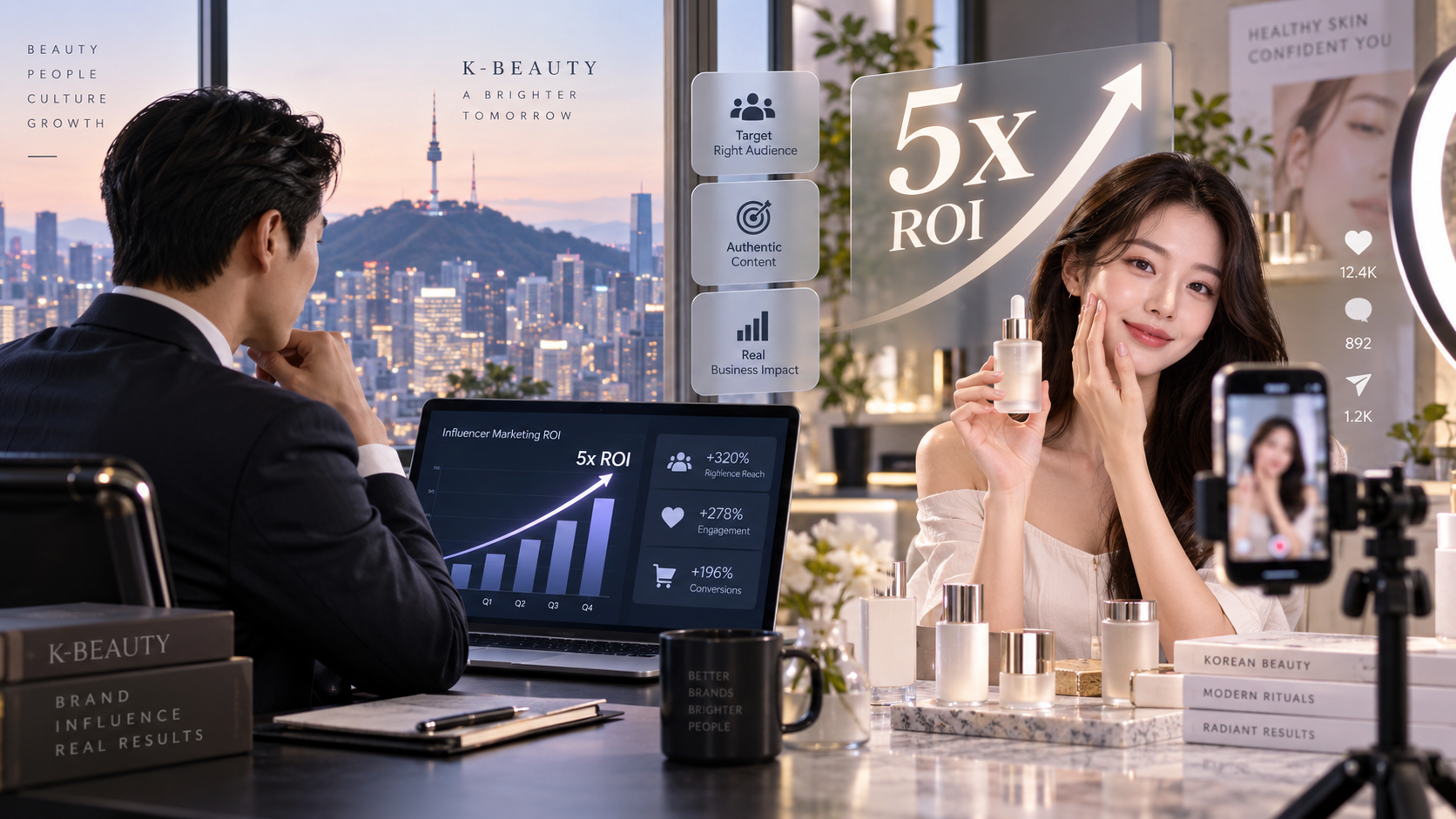
K-beauty influencer marketing is no longer just a branding tactic. For founders and CEOs, it can become a measurable customer-acquisition channel when creator selection, paid media, retargeting, conversion tracking, and product economics are managed as one system.
That matters because K-beauty itself is expanding rapidly. Korean cosmetics exports reached a record USD 10.2 billion in 2024, up 20.3% from 2023. In 2025, exports climbed again to approximately USD 11.4 billion, setting another record. The United States became Korea’s largest cosmetics export market, ahead of China and Japan.
The opportunity is real. But many small and midsize beauty companies still approach marketing cautiously, often because of high influencer fees, difficulty measuring attribution, or negative experiences with campaigns that produced attention without enough sales.
The solution is not simply to spend more on influencers. It is to build a more disciplined K-beauty influencer marketing strategy around audience fit, content quality, distribution, conversion, and customer economics.
1. Why K-Beauty Creates a Large Influencer Marketing Opportunity
K-beauty is no longer a niche export story.
According to Korea’s Ministry of Food and Drug Safety, Korean cosmetics exports reached USD 10.2 billion in 2024, placing Korea among the world’s largest cosmetics exporters.
The momentum continued in 2025. Cosmetics exports reached approximately USD 11.4 billion, and Korea became the world’s second-largest cosmetics exporter.
The export base also became more diversified. Korean cosmetics were exported to 202 countries in 2025, up from 172 in 2024.
The United States became the largest destination for Korean cosmetics exports in 2025 at about USD 2.2 billion, followed by China at roughly USD 2.0 billion and Japan at approximately USD 1.1 billion.
Skincare remained the dominant category, with exports of about USD 8.54 billion in 2025.
For founders and CEOs, those numbers show that international demand for K-beauty is not hypothetical. The challenge is capturing that demand efficiently.
2. Why Some Founders Still Hesitate to Invest in Influencer Marketing
Despite the growth of K-beauty, some founders remain cautious about influencer marketing.
Their concerns are understandable.
- Top creators can be expensive.
- Follower counts do not guarantee sales.
- Attribution can be difficult.
- Some campaigns generate engagement but weak conversion.
- Agencies may report impressions without connecting them to revenue.
- Brands can overspend before proving product-market fit.
These problems are real, but they are usually arguments for better campaign design, not for avoiding influencer marketing entirely.
The mistake is treating an influencer post as the whole campaign.
A stronger model treats creator content as one part of a broader customer-acquisition system that includes paid amplification, retargeting, landing pages, offers, conversion tracking, and repeat-purchase economics.
3. Product-Market Fit Comes Before Influencer Marketing
No marketing strategy can permanently compensate for a product consumers do not want.
Before investing heavily in K-beauty influencer marketing, a brand should understand:
- who the product is designed for
- what problem it solves
- why consumers should choose it over alternatives
- whether the price matches perceived value
- whether repeat purchase is realistic
- whether claims and positioning are credible
In a highly competitive skincare market, product-market fit is often the difference between a campaign that creates temporary attention and one that creates profitable growth.
4. How to Structure a K-Beauty Influencer Marketing Campaign
Consider an illustrative skincare brand launching an anti-aging serum for women aged approximately 30–45.
The business objective is not simply to maximize impressions. The campaign should aim to:
- increase qualified awareness
- generate product consideration
- drive measurable website traffic
- acquire new customers
- create reusable creator content
- build a retargeting audience
- improve repeat-purchase potential
Define the audience before selecting influencers
A useful audience definition may include women in urban areas who actively engage with skincare, anti-aging, wellness, beauty education, and premium personal-care content.
More importantly, the brand should identify what motivates the purchase: visible results, preventative skincare, ingredient quality, convenience, prestige, clinical credibility, or another benefit.
5. Choosing Macro and Micro Influencers
Influencer selection should be based on audience relevance and content performance, not simply follower count.
Macro influencers
Larger creators can provide reach, social proof, and high-production-value content. They may be especially useful for:
- launch awareness
- hero product demonstrations
- tutorial videos
- brand storytelling
- content that can later be amplified with paid media
Micro influencers
Smaller creators can be valuable when they have highly relevant communities and strong audience trust.
A portfolio approach may be more effective than betting the entire campaign on one celebrity or large creator.
Instead of asking only, “How many followers does this influencer have?” ask:
- Does the audience match our customer?
- Is the engagement authentic?
- Does the creator already discuss similar products?
- Do followers ask purchase-related questions?
- Can the content be reused in paid advertising?
- Does the creator’s style fit the brand?
6. Build Influencer Content for Conversion, Not Just Reach
The best-performing creator content often does more than display a product.
It gives the viewer a reason to care.
Useful content formats include:
- product demonstrations
- skincare routines
- ingredient education
- texture and application videos
- before-and-after stories where appropriate and compliant
- problem-solution content
- comparison content
- longer-form YouTube reviews
- short-form Instagram Reels and TikTok content
The content should also include a clear next step, such as visiting the product page, learning more, subscribing, using a creator-specific code, or purchasing through a trackable link.
7. Use Paid Media to Amplify Winning Influencer Content
One of the biggest mistakes brands make is allowing successful influencer content to disappear after the initial organic post.
If creator content generates strong engagement, clicks, or conversions, it can be amplified through paid media.
This changes the economics of influencer marketing.
Instead of paying only for access to an influencer’s existing audience, the brand gains a piece of validated creative that can potentially reach much larger and more targeted audiences.
Retarget interested users
Many consumers will not purchase after their first exposure.
Retargeting allows brands to reach people who:
- watched creator videos
- engaged with campaign content
- visited the product page
- added products to cart
- began checkout but did not purchase
This is why influencer marketing should be connected to the paid-media and conversion strategy rather than managed as an isolated activity.
8. A More Realistic K-Beauty Influencer Marketing ROI Model
ROI projections should be treated carefully.
The following example is an illustrative scenario, not a guarantee of campaign performance.
Illustrative campaign budget
- Influencer partnerships: $50,000
- Content and production: $10,000
- Paid amplification and retargeting: $30,000
- Strategy and campaign management: $10,000
- Total investment: $100,000
Illustrative funnel assumptions
Instead of assuming that a fixed percentage of everyone reached will immediately purchase, model the campaign as a funnel.
- Total qualified reach/impressions: 1,000,000
- Traffic rate: 2.5%
- Website visits: 25,000
- Purchase conversion rate: 4%
- Initial orders: 1,000
- Average order value: $70
- Initial attributable revenue: $70,000
On first purchase alone, this scenario would not yet produce an attractive return on a $100,000 investment.
That is exactly why CEOs should evaluate more than immediate revenue.
Customer lifetime value changes the equation
Skincare products can create repeat-purchase opportunities. If the brand acquires customers efficiently and a meaningful portion of them reorder, the economics can improve substantially over time.
For example, if 1,000 new customers generate $70,000 in initial revenue and subsequent purchases contribute another $60,000 during the measurement period, attributable revenue becomes $130,000.
That would represent:
- Marketing spend: $100,000
- Attributed revenue: $130,000
- Revenue-to-spend ratio: 1.3x
Whether the campaign is profitable then depends on gross margin, fulfillment costs, repeat purchase, customer acquisition cost, and other operating expenses.
A 5x return is possible in some circumstances, but it should be treated as a target or scenario outcome—not as an automatic result of influencer marketing.
9. Understand the Difference Between ROAS and ROI
Founders should distinguish between ROAS and ROI.
ROAS
Return on ad spend compares attributed revenue with advertising or campaign spend.
For example:
$500,000 in attributed revenue ÷ $100,000 in campaign spend = 5x ROAS.
ROI
ROI considers the return relative to the investment and should ideally account for the economic costs associated with generating the revenue.
Revenue is not the same as profit.
Product cost, logistics, marketplace fees, discounts, influencer fees, paid media, agency fees, and overhead can all affect the true financial return.
10. Metrics CEOs Should Actually Track
Follower count and likes are not enough.
A serious K-beauty influencer marketing program should monitor metrics across the entire funnel.
Awareness metrics
- qualified reach
- video views
- view-through rate
- engagement rate
- brand search lift
Traffic metrics
- link clicks
- landing-page visits
- cost per qualified visitor
- creator-specific traffic
Conversion metrics
- conversion rate
- new customers
- customer acquisition cost
- average order value
- cost per acquisition
Long-term metrics
- repeat purchase rate
- customer lifetime value
- retention
- organic branded search growth
- revenue from retargeted audiences
11. Key Success Factors for K-Beauty Influencer Marketing
Audience fit
The influencer’s audience should resemble the brand’s desired customer.
Authenticity
Creator recommendations need to feel credible. Forced endorsements can generate reach without trust.
Strong creative
The content needs to communicate product benefits clearly enough to work both organically and in paid amplification.
Conversion infrastructure
A strong influencer post cannot compensate for a weak product page, confusing checkout process, poor offer, or slow website.
Retargeting
Interested users who do not buy immediately should have an opportunity to encounter the brand again.
Measurement
Use trackable links, creator codes, analytics, pixels, platform attribution, and post-purchase data where appropriate.
Repeat purchase economics
For skincare brands, the real value of a new customer may extend well beyond the first order.
The CEO Takeaway: Influencer Marketing Is a System, Not a Post
The strongest business case for influencer marketing is not that creators have large audiences.
It is that high-quality creator content can become part of an integrated acquisition engine.
The system can include:
- audience research
- creator selection
- authentic content
- organic distribution
- paid amplification
- retargeting
- conversion optimization
- customer retention
- lifetime-value measurement
When those pieces work together, influencer marketing becomes much easier to evaluate as a business investment.
Frequently Asked Questions About K-Beauty Influencer Marketing
Is influencer marketing effective for K-beauty brands?
It can be effective when the creator audience matches the target customer, the content is credible, and the campaign is connected to paid media, conversion tracking, and customer acquisition goals.
Are micro influencers better than macro influencers?
Neither category is automatically better. Macro influencers can provide scale, while micro influencers can offer niche relevance and strong community trust. Many campaigns benefit from using both.
Can K-beauty influencer marketing generate a 5x return?
It is possible, but no return should be assumed or guaranteed. Performance depends on product-market fit, audience quality, creator selection, creative effectiveness, conversion rate, average order value, repeat purchase, media costs, and other factors.
What is the difference between 5x ROAS and 5x ROI?
A 5x ROAS generally means five dollars in attributed revenue for every dollar of advertising spend. ROI is broader and considers the return relative to the investment and underlying costs.
What should a CEO look at before approving an influencer campaign?
Review product-market fit, target audience, expected customer acquisition cost, creator relevance, content rights, paid amplification plans, conversion tracking, gross margin, repeat-purchase potential, and the measurement framework.
Conclusion: K-Beauty Influencer Marketing Needs a Business Case
K-beauty is expanding globally, and the numbers support the opportunity. Korean cosmetics exports reached record levels in 2024 and again in 2025, with the United States becoming the industry’s largest export destination.
But market growth alone does not guarantee brand success.
CEOs and founders should evaluate influencer marketing the same way they evaluate other growth investments: through customer economics, measurable conversion, risk, and long-term value.
The strongest K-beauty influencer marketing strategies combine creators, paid media, retargeting, conversion optimization, and customer retention rather than relying on influencer reach alone.
That is where influencer marketing can move from an uncertain marketing expense to a measurable growth system.
Sources
Note: Campaign figures and ROI examples in this article are illustrative scenarios and are not guarantees of future performance. Actual results vary based on product, pricing, margins, market conditions, creative performance, targeting, attribution, and customer behavior.