Overcoming Regulatory Hurdles: A Guide for Asian Cosmetic Brands Entering Developed Markets
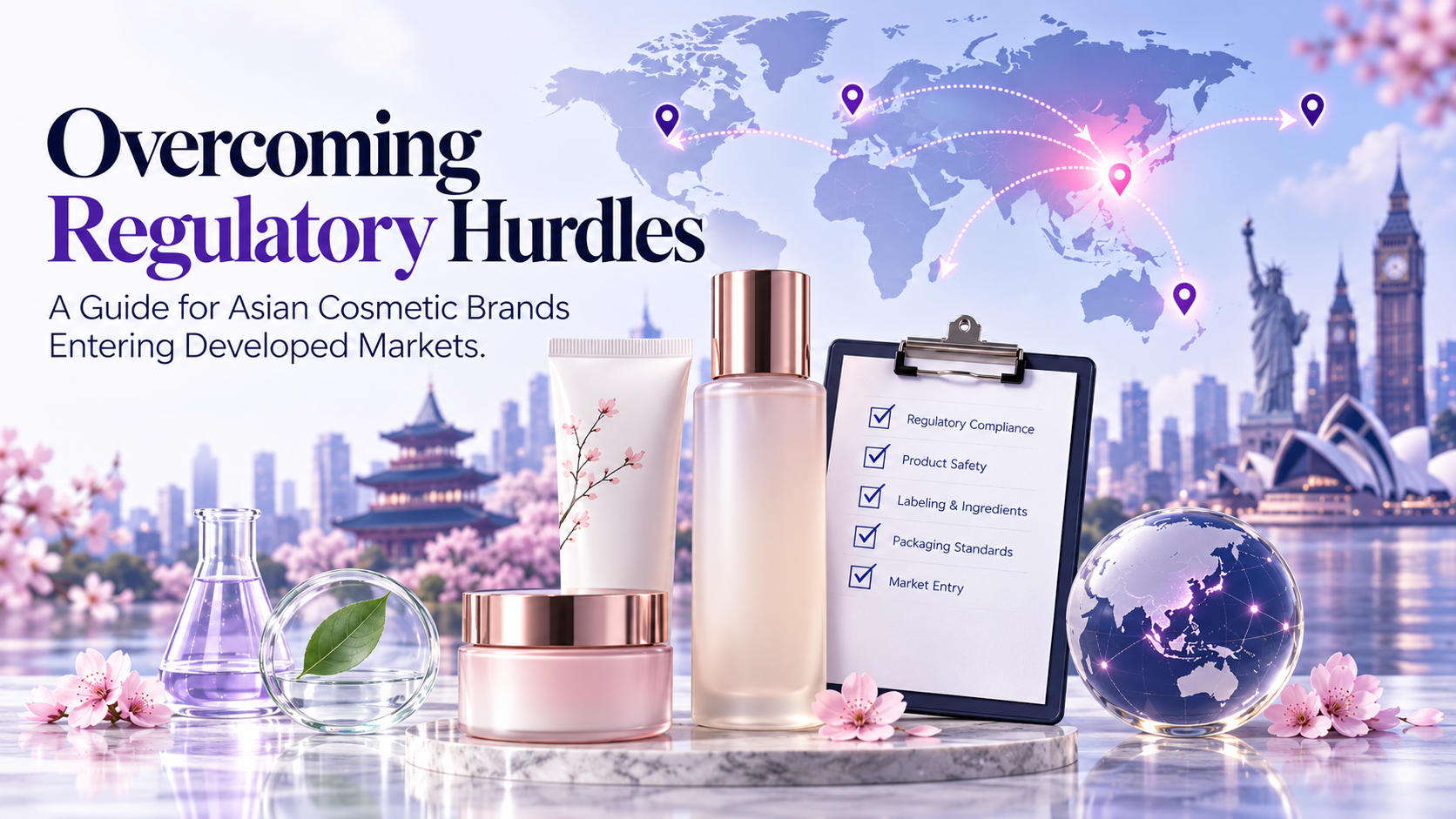
Asian beauty brands have transformed the global cosmetics industry through innovative formulations, distinctive ingredients, advanced skincare routines, and fast-moving product development. As demand for Asian beauty products grows, many brands are looking beyond their home markets toward the United States, Europe, Canada, Australia, and other developed economies.
The opportunity is significant, but entering a new country involves much more than translating packaging or finding a distributor. One of the most important challenges is cosmetic regulatory compliance. Regulations can determine which ingredients may be used, what claims may appear on packaging, what safety evidence must be maintained, and even who is legally responsible for the product in the destination market.
For an Asian cosmetic brand planning international expansion, regulatory preparation should therefore begin well before a product reaches customs or a retailer. This guide explains the major areas brands should evaluate and provides a practical framework for preparing for market entry.
1. Cosmetic Regulatory Compliance Starts With Understanding Each Market
Cosmetics regulations are not globally standardized. A formulation, ingredient, claim, or package that is acceptable in one country may require modification before it can be sold in another.
United States
Cosmetics in the United States are regulated by the U.S. Food and Drug Administration. The Modernization of Cosmetics Regulation Act, commonly known as MoCRA, significantly expanded federal requirements for the cosmetics industry.
Depending on the business and product, requirements can include cosmetic facility registration, product listing, safety substantiation, adverse-event reporting, labeling compliance, and recordkeeping. Cosmetic product registration or listing should not be confused with FDA pre-market approval; most cosmetics are not individually approved by the FDA before sale.
European Union
Cosmetics sold in the European Union are governed primarily by Regulation (EC) No 1223/2009. A product must have an EU-based Responsible Person before being placed on the market.
Brands must also address requirements such as a Cosmetic Product Safety Report, a Product Information File, good manufacturing practice, appropriate labeling, claims substantiation, and product notification before market placement.
Canada
Health Canada regulates cosmetics under the Food and Drugs Act and Cosmetic Regulations. Manufacturers and importers are responsible for ensuring that products meet applicable ingredient, safety, notification, and labeling requirements.
A Cosmetic Notification Form must generally be submitted to Health Canada within 10 days after a cosmetic is first sold in Canada. Notification is not the same as government approval of the product.
Australia
In Australia, cosmetic ingredients used for industrial purposes generally fall under the Australian Industrial Chemicals Introduction Scheme (AICIS). Whether a product is considered a cosmetic or a therapeutic good depends partly on its ingredients, intended use, and marketing claims.
Products making therapeutic claims may instead fall within the jurisdiction of the Therapeutic Goods Administration. This distinction is particularly important for products such as certain sunscreens, skin-whitening products, and products promoted with medical or therapeutic claims.
2. Review Ingredient Compliance Before Entering a New Market
Ingredient review is one of the most important parts of cosmetic regulatory compliance. Brands should never assume that an ingredient permitted in Korea, Japan, China, or another Asian market will automatically be permitted at the same concentration and for the same use elsewhere.
Check prohibited and restricted substances
Each market maintains its own rules regarding prohibited substances, restricted ingredients, preservatives, colorants, UV filters, fragrances, and other cosmetic ingredients.
Before committing to production for export, conduct a complete review of the formulation against the requirements of the destination market.
Create a market-ready ingredient database
Brands planning expansion into several countries can reduce future reformulation costs by maintaining a regulatory database for every formulation. Useful information includes:
- INCI name for each ingredient
- CAS number where applicable
- ingredient concentration
- function within the formulation
- supplier documentation
- safety information
- market-specific restrictions
Pay special attention to new ingredients and nanomaterials
Innovative ingredients can be commercially valuable, but they may also create additional regulatory work. New substances, nanomaterials, and ingredients with limited safety histories may require additional documentation or assessment.
Discuss regulatory requirements with ingredient suppliers early. A supplier that can provide complete safety, specification, and technical documentation can significantly reduce delays during market entry.
3. Build Product Safety Into the Market Entry Process
Developed markets increasingly expect cosmetic companies to maintain evidence demonstrating product safety. Waiting until a distributor, regulator, or retailer requests documentation can create expensive delays.
Common areas of product safety evaluation
- Microbiological quality: Evaluating contamination risk and product preservation.
- Stability: Assessing whether the formula and packaging remain suitable throughout the intended shelf life.
- Compatibility: Evaluating interaction between the product and its packaging.
- Skin tolerance: Assessing irritation or sensitization risk where appropriate.
- Toxicological information: Maintaining appropriate safety information for ingredients and exposure.
The EU requires particularly structured documentation
Before an EU cosmetic is placed on the market, the Responsible Person must ensure that the product has undergone the required safety assessment and that a Cosmetic Product Safety Report has been prepared.
The Product Information File should contain relevant product information, including the safety report, manufacturing information, support for product claims where appropriate, and other required documentation.
Companies entering several European countries should treat the Product Information File as a controlled regulatory document rather than a last-minute collection of certificates.
4. Treat Labeling and Marketing Claims as Regulatory Issues
A compliant formulation can still encounter regulatory problems if its packaging or marketing language does not meet local requirements.
Use internationally recognized ingredient nomenclature
Cosmetic labels commonly rely on International Nomenclature of Cosmetic Ingredients, or INCI, terminology. Brands should verify the correct nomenclature and required presentation for each target market.
Be careful with cosmetic claims
Claims such as “anti-aging,” “clinically proven,” “hypoallergenic,” “dermatologist tested,” “natural,” or “organic” should never be treated as casual marketing language.
The exact wording of a claim can influence how regulators classify and evaluate a product. In some jurisdictions, claims that imply treatment, prevention, or modification of a medical condition can move a product beyond the cosmetic category.
Maintain evidence behind performance claims
Strong claim substantiation may include:
- controlled clinical studies
- instrumental testing
- consumer perception studies
- laboratory testing
- published scientific evidence
- ingredient-specific evidence where appropriate
The evidence should support the actual wording used in advertising, packaging, e-commerce listings, influencer campaigns, and other marketing communications.
5. Include Packaging in Your Cosmetic Regulatory Compliance Review
Packaging is no longer only a branding decision. Environmental rules, recycling requirements, extended producer responsibility programs, waste reduction initiatives, and retailer sustainability standards are becoming increasingly important across developed markets.
Design packaging with multiple markets in mind
Brands planning international expansion should evaluate packaging before final production. Questions to consider include:
- Can the package accommodate required local-language information?
- Are mandatory warnings clearly visible?
- Does the container protect the formulation throughout its shelf life?
- Can materials be recycled within the target market?
- Are additional recycling or disposal symbols required?
- Does the packaging meet retailer sustainability expectations?
A packaging design that works across several markets can reduce SKU complexity and simplify international expansion.
6. Prepare for Import, Distribution, and Retail Compliance
Regulatory approval or notification is only one component of international market entry. Asian cosmetic brands also need a practical strategy for importation, logistics, distribution, retail, and e-commerce.
Prepare a regulatory dossier before launch
A well-organized product dossier can make collaboration with importers, distributors, retailers, and regulatory advisers significantly easier. Depending on the market, the dossier may include:
- complete formulation and ingredient information
- product specifications
- safety documentation
- stability and microbiological information
- manufacturing documentation
- label artwork
- claims substantiation
- packaging specifications
- certificates requested by distributors or retailers
Do not overlook retailer requirements
Major retailers and e-commerce platforms may impose standards beyond minimum government requirements. These can include prohibited ingredient lists, sustainability policies, testing standards, product liability requirements, barcode specifications, packaging standards, and marketing restrictions.
Brands should therefore investigate both government regulations and channel-specific requirements before finalizing a market-entry plan.
7. Build a Repeatable Cosmetic Regulatory Compliance Strategy
Regulatory compliance should not be treated as a one-time hurdle before launch. Regulations, ingredient restrictions, labeling standards, and sustainability requirements continue to evolve.
A scalable international beauty business needs a repeatable process.
- Select the target market. Understand the product category, consumer opportunity, competition, regulatory environment, and distribution channels.
- Conduct a formulation review. Compare every ingredient and concentration against local requirements.
- Identify responsible parties. Determine whether a local Responsible Person, importer, distributor, notifier, or other legal representative is required.
- Compile safety documentation. Complete testing and gather supporting technical information before launch.
- Review packaging and claims. Evaluate labels, translations, marketing claims, warnings, and sustainability requirements.
- Complete notification or registration obligations. Follow the applicable procedure in each destination market.
- Coordinate marketing with compliance. Make sure advertising, influencers, e-commerce listings, and sales materials remain consistent with approved product positioning.
- Monitor regulatory changes. Periodically review ingredients, claims, packaging, and documentation after launch.
Why Regulatory Preparation Can Become a Competitive Advantage
Compliance is often viewed as a cost of international expansion. In practice, strong regulatory preparation can become a competitive advantage.
A brand that can provide complete documentation, compliant packaging, substantiated claims, and reliable product information is easier for distributors and retailers to work with. It can also respond faster when opportunities arise in new markets.
Most importantly, strong cosmetic regulatory compliance reduces the risk of product delays, recalls, rejected shipments, forced relabeling, retailer disputes, and damage to consumer trust.
Frequently Asked Questions About Cosmetic Regulatory Compliance
Do Asian cosmetic brands need FDA approval before selling in the United States?
Most cosmetic products are not individually approved by the FDA before entering the U.S. market. However, companies must comply with applicable U.S. cosmetic laws and MoCRA requirements, which can include facility registration, product listing, safety substantiation, labeling, and adverse-event obligations.
Does an Asian cosmetic brand need an EU Responsible Person?
A cosmetic product placed on the EU market must have a designated Responsible Person established within the European Union who ensures compliance with applicable requirements.
Can the same cosmetic formulation be sold worldwide?
Sometimes, but not always. Ingredient restrictions, permitted concentrations, labeling rules, claims requirements, and product classifications vary between markets. Formulation review should therefore take place before international commercialization.
Are cosmetic claims part of regulatory compliance?
Yes. Claims can affect regulatory classification and must be appropriately substantiated. A cosmetic claim should accurately represent the product and be supported by suitable evidence.
When should regulatory planning begin?
Ideally, regulatory planning should begin during market selection and product development, before final formulas, packaging, labels, or marketing claims are locked.
Conclusion: Prepare for Compliance Before You Enter the Market
Developed markets offer substantial opportunities for Asian cosmetic brands, but successful expansion requires more than strong products and attractive branding.
Ingredient compliance, product safety, regulatory documentation, labeling, claims, packaging, import requirements, and local market practices all need to work together.
Brands that address these requirements early can reduce launch risk, accelerate relationships with distributors and retailers, and establish greater trust with consumers.
Ultimately, cosmetic regulatory compliance should be treated as part of the market-entry strategy—not as an administrative task that begins after the marketing plan is already complete.
Disclaimer: This article is provided for general informational purposes and does not constitute legal or regulatory advice. Cosmetic regulations change over time and vary by product and jurisdiction. Companies should consult qualified regulatory professionals and the appropriate government authorities before placing products on the market.